
For many, the word “marketing” still brings up romantic images of the Mad Men era – creative chaos, intuition, and the infamous three-martini lunch. But that world, if it ever truly existed, is long gone.
Today, sustainable strategies aren’t born in smoke-filled rooms; they are shaped by the glow of analytics dashboards. Yet, the question worth asking is not “how”, but “why”. Why do so many leaders still treat data as a look in the rearview mirror rather than a map for the road ahead?
If you ignore the data, you are essentially setting sail across a vast ocean with nothing but gut instinct to guide you. You might get lucky, or you might find yourself lost in the fog.
Data is the compass and radar for your business
Too many leaders treat data as a historical record – a report card on past performance. This is a mistake. Data isn’t just a look in the rearview mirror; it’s your business’s essential, real-time navigation system. Ignoring it is like setting sail across the ocean with nothing but your gut instincts to guide you.

Think of your business as a ship on the vast marketing sea. In this analogy, your data serves two critical functions:
- Your compass and maps
Quantitative and qualitative data are the navigational tools that tell you which direction to sail. They show you where you are, where you want to go, and the most efficient route to get there. Without them, you’re just drifting. - Your Radar
Data also functions as a radar system, showing you where other ships are. It helps you understand the competitive landscape and market movements, so you know when to turn to avoid a collision or seize an opportunity.
Sailing on intuition alone is a high-risk strategy. You might get lucky, or you might find yourself hopelessly lost in the “marketing fog,” wasting precious resources on tactics that lead nowhere. At worst, you risk a catastrophic failure that could have been easily avoided. To navigate effectively, you need to understand the different readings on your ship’s dashboard – the specific types of data that give you a complete picture of the journey.
The two types of navigational data you need
Your dashboard gives you two types of readings. One tells you what is happening (quantitative data), and the other tells you why (qualitative data). A captain who only looks at the speedometer without understanding the engine is flying blind. You must master both.
The “What”: quantitative data & the siren’s call of vanity metrics
Quantitative data consists of the measurable numbers that tell you what is happening in your marketing efforts. These are the figures you can easily put into a spreadsheet or a chart: website users from Google Analytics, ad clicks from a social media campaign, or the number of likes on a post.
However, don’t fall for the siren’s call of “vanity metrics.” These are numbers that look impressive on the surface but offer little real business value. The classic example is having two million Instagram followers that generate no meaningful engagement or sales. A client might set a goal to “get a million followers,” but the critical question is always, “To what end?” Chasing vanity metrics isn’t just a strategic distraction; it’s a direct misallocation of capital; budget that could be driving real sales is wasted chasing numbers that don’t impact the bottom line.
The “Why”: qualitative data & discovering your True North
While quantitative data tells you what happened, qualitative data tells you why. It’s the key to unlocking your customers’ motivations, needs, and pain points – the deep insights that fuel breakthrough strategies. This data is less about numbers and more about context and meaning.
You can find it by:
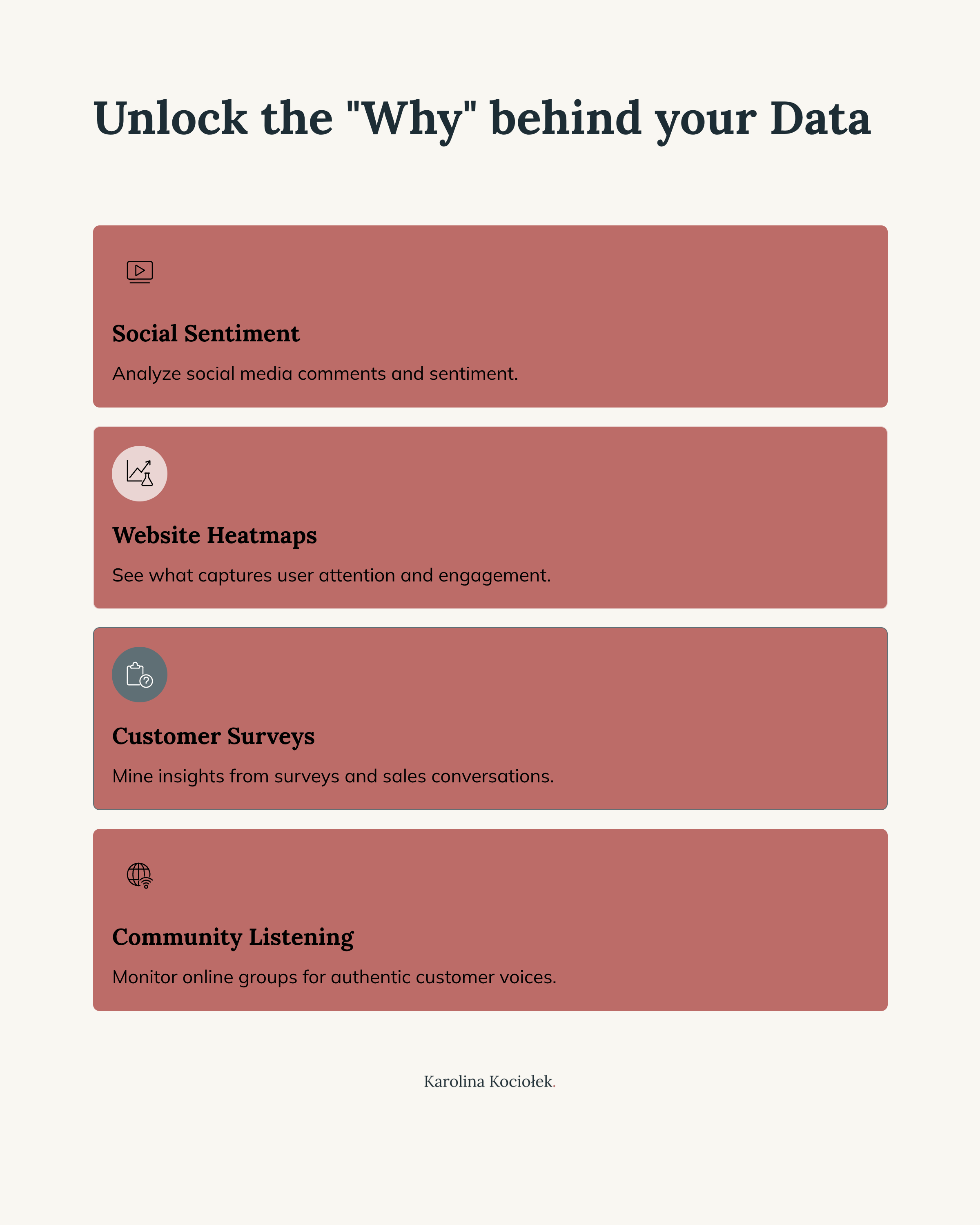
- Analyzing the content and sentiment of comments on your social media.
- Using website heatmaps to see which elements actually capture user attention.
- Mining insights from customer surveys or, even better, conversations your sales team has every day.
- Listening in on conversations in niche, private Facebook groups or online forums to hear what customers say when they think no one is marketing to them.
This is where you find the powerful consumer insights that change the game. The thinking behind a famous candy bar slogan, “you’re not you when you’re hungry,” didn’t come from a spreadsheet. It came from observing a universal human truth. Once you can read both your speedometer (quantitative) and your customer sentiment reports (qualitative), you can begin making truly informed decisions.
From insights to action: turning data into smarter decisions
Data is not an academic exercise; it is the single most effective tool you have to protect your capital and grow your business. Every data point should be a catalyst for a smarter decision. Here’s how you make that connection tangible.
Three ways data protects your bottom line
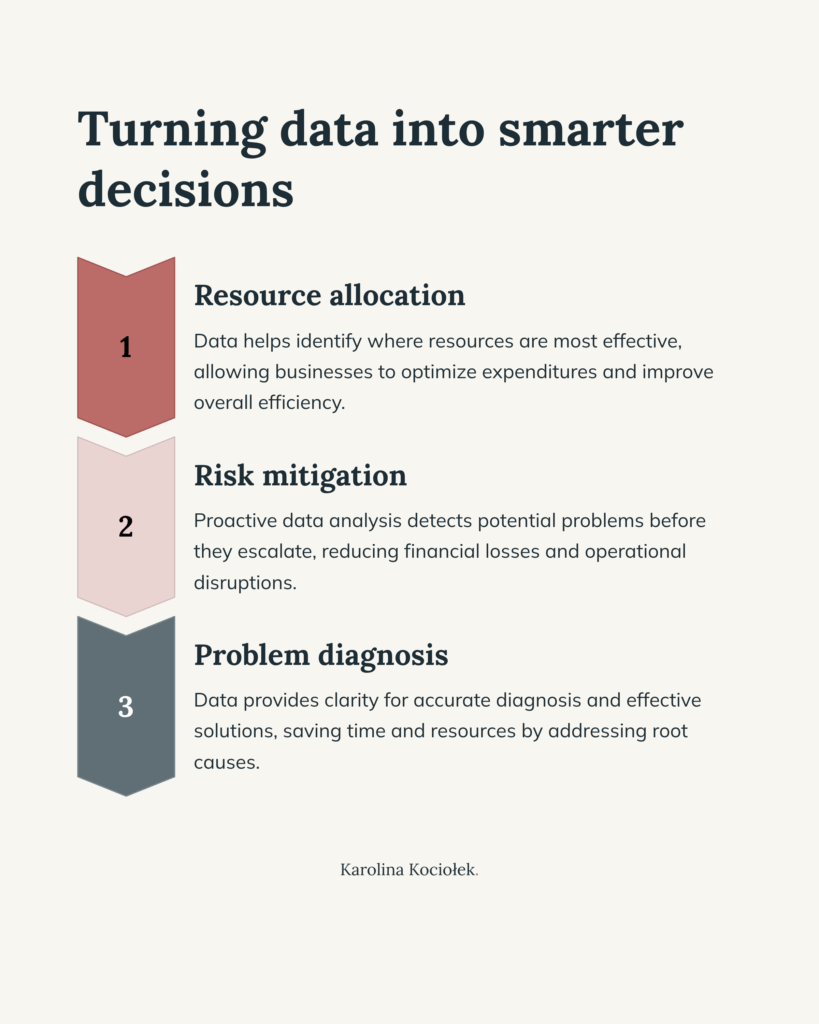
- Resource allocation
By tracking performance across different channels, you can make informed choices about where to increase marketing budgets for maximum return and where to cut back to eliminate waste. - Risk mitigation
Data allows you to test new ideas on a small, low-cost scale before committing significant resources. I saw this firsthand with a campaign concept that seemed brilliant in the boardroom. We tested it locally with a small budget and discovered it was five times more expensive than our usual efforts. We scrapped the idea before wasting serious time and money. - Problem diagnosis
Data helps you uncover hidden issues that are silently killing your bottom line. For one client, campaign clicks were high, but sales were weak. The data showed that website page views were half the number of clicks. A quick investigation revealed the mobile site was loading so slowly that most users gave up before the products even appeared. Without data, that problem would have remained invisible.
Making these smart decisions relies on having the right instruments at your disposal and they are far more accessible than many leaders believe.
Instruments of Clarity
Clarity rarely comes from adding more — it comes from removing noise.
The concept of a “data stack” often sounds intimidating, implying expensive software and complex integrations. At first glance, this may seem straightforward, yet many business leaders hesitate, believing they lack the budget for proper analytics.
This is a misconception. Many of the most powerful navigational instruments are accessible and often free. The technology itself is secondary; what implies value is the skilled human captain interpreting the output.
This is where thinking turns into structure. You do not need a massive enterprise setup to start. You simply need instruments that measure two things: the What and the Why.
The Accessible Dashboard
The goal is alignment, not perfection. Here is a streamlined approach for startups and small businesses to begin navigating immediately:
| Strategic Focus | The Purpose | Accessible Instruments |
| Quantitative | The “What” Measuring behavior and hard numbers. | • Google Analytics (Free) • Native Social Insights (LinkedIn/Facebook) • Excel / Google Sheets |
| Qualitative | The “Why” Understanding sentiment and context. | • Social Listening (Brand24, Sprout Social) • Survey Tools (Typeform) • Google Alerts |
A note on artificial intelligence
In the current landscape, AI serves as a helpful “first mate.” It is excellent for summarizing trends or mapping large volumes of comments. However, context changes the meaning of every metric.
AI often fails to grasp human nuances, such as irony or sarcasm in customer feedback, which can lead to flawed conclusions.
Technique is not a substitute for insight. Never abdicate your role as captain. The final strategic decision must rest with a human who can connect the dots and steer the ship. With these accessible tools, there is no excuse not to begin.
Set sail today – don’t wait for a bigger ship
Data-driven marketing is not a luxury reserved for large corporations with massive budgets. It is a fundamental, accessible practice and an absolute necessity for businesses of all sizes. Don’t wait until you have a bigger team or a more sophisticated tech stack. Start now, even on a small scale. Begin by measuring your results regularly, month over month and year over year, to establish your benchmarks.
For a smaller business, measurement is not just important – it is existential. While a market leader can afford to make a mistake, a smaller organization must be ruthlessly efficient. Every dollar and every hour counts, and the cost of error is significantly higher. Data allows you to test faster, learn faster, and iterate your way to success.
The marketing ocean is vast, but with the right map and compass, even the smallest ship can navigate it successfully. It’s time to take the helm.
If you want to start navigating your marketing strategy, let’s check more about me and talk about the possibility of contributing.
Leave a Reply