
The art of observation: how to audit competitors without losing yourself?
In many cases, the real challenge lies elsewhere. When we see a competitor scaling, the instinct is to ask “How are they doing it?” followed immediately by “We should do that too.”
It seems logical. But a strategy built on imitation is fragile.
Conducting a competitive digital marketing audit is not about copying tactics. It is about understanding the landscape so you can navigate it differently. It is about separating the signal from the noise.
Here is how to approach competitive intelligence with clarity, using data to inform, not dictate, your decisions.
The trap of “visible success”
At first glance, this may seem straightforward. You see a competitor launching a massive influencer campaign or flooding Instagram with ads. You assume it’s working.
But visible activity does not equal profitability.
- High ad spend might mean they are desperate to acquire customers to please investors.
- Frequent discounts might indicate they are struggling with retention.
Context changes the meaning of every metric. If you copy their tactics without their context (their budget, their margins, their brand equity), you simply import their hidden problems into your business.
The Meta Ads example
This is where thinking turns into structure. Let’s look at a tangible way to analyze competitors: The Meta Ads Library.
This is a powerful tool. It allows you to see every active ad a brand is running.
- The Wrong Way: Looking at their creatives, saying “That looks nice,” and sending it to your designer to replicate.
- The Strategic Way: Looking for patterns and intent.
What to look for:
- Longevity: Are there ads that have been running for 3+ months? These are likely their winners.
- Testing: Are they testing 10 variations of the same headline? This tells you they are refining their messaging – and you can learn what didn’t work by seeing what disappears.
- The Angle: Are they selling “features” or “feelings”?
The Strategist’s Warning: Just because a competitor is running an ad doesn’t mean it’s converting. Not all growth is sustainable. Use the library to understand their positioning, not to steal their creative.
The power of contrast
The most revealing insights often come from a competitive digital marketing audit comparing two brands, specifically, a market leader and a challenger.
From a strategic perspective, this highlights the “Why.”
Take Zendesk (the giant) vs. Help Scout (the challenger).
- If you audit Zendesk, you see complexity, enterprise jargon, and vast feature lists.
- If you audit Help Scout, you see simplicity, human language, and a focus on “customer love.”
If Help Scout had tried to copy Zendesk’s complex ads, they would have failed. Instead, they used the audit to find the gap. They realized that for many businesses, Zendesk was “too much.” They positioned themselves as the antidote to complexity.
There is no universal solution, only relevant ones. Your audit should tell you where the market is crowded, so you can go where it is empty.
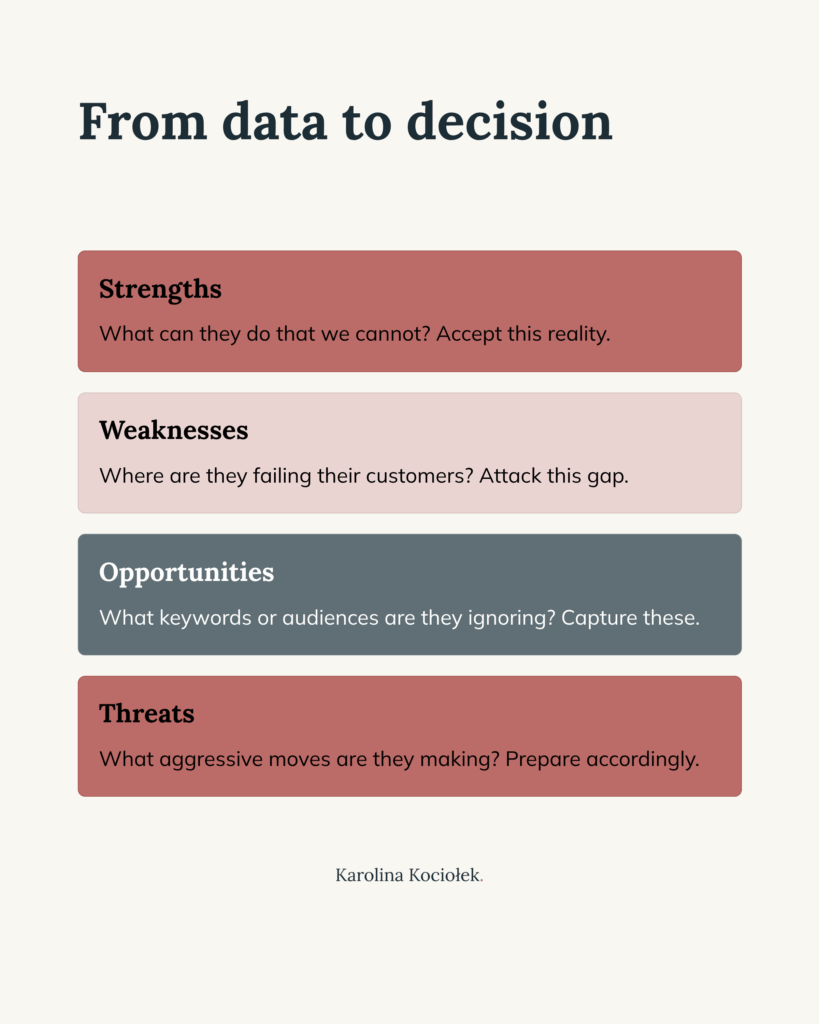
From data to decision
Clarity rarely comes from adding more — it comes from removing noise. Once you have gathered data from Meta Ads, SEO tools, or content reviews, you must filter it through your own strategy.
Classic frameworks like SWOT often get ignored for shiny new tools. That’s a mistake. In strategic planning, we use SWOT to filter signal from noise:
- Strengths: What can they do that we cannot? (Accept this).
- Weaknesses: Where are they failing their customers? (Attack this).
- Opportunities: What keywords or audiences are they ignoring?
- Threats: What aggressive moves are they making?
This approach is designed for brands thinking long-term. It moves you from reactive panic (“We need a TikTok strategy because they have one!”) to intentional action (“We will double down on Email because they are ignoring retention”).
A strategic perspective on how to audit competitors
The strongest brands are built quietly and consistently. They do not chase every trend their rivals jump on. They observe, they analyze, and then they execute a strategy that is uniquely their own.
Good collaboration starts with shared clarity. If you are ready to look at your market with fresh eyes and without the noise, let’s approach this thoughtfully. Start with an audit, not a campaign.
Leave a Reply